


Breadcrumbs
These links will help you get back to where you want to go faster.
Why Your Arizona Home Feels Humid After Monsoon Season
Indoor Humidity and HVAC Solutions
Arizona’s monsoon season dramatically transforms the desert’s famously dry environment into one saturated with moisture, creating unique indoor humidity challenges for homeowners. From June through September, residents in Florence and throughout Arizona often notice their homes feeling sticky, clammy, and uncomfortable despite running air conditioners continuously. If your AC seems to cool the air but leaves the dampness untouched, you’re facing a widespread issue driven by both Arizona’s climate and the limitations of typical residential HVAC systems.
At Allstate Air and Heating, LLC, we combine scientific insight and advanced HVAC technology to help homeowners maintain comfortable indoor humidity levels year-round. This comprehensive article explores why post-monsoon indoor humidity spikes occur, the inherent challenges your AC system faces, common HVAC pitfalls, health risks, and proven strategies to reclaim dry, comfortable air in your home.
What you will learn in this article:
– Arizona’s monsoon season brings a sudden and significant increase in outdoor and indoor humidity, causing homes to feel damp and uncomfortable despite air conditioning.
– Typical residential HVAC systems mainly focus on sensible cooling (temperature reduction) and often struggle with latent cooling (moisture removal), especially during high humidity periods.
– Oversized AC units short-cycle by cooling quickly but shutting off before adequately dehumidifying, leaving indoor humidity high.
– Common HVAC problems worsening humidity include clogged filters, leaky or poorly insulated ducts, clogged condensate drains, and improper refrigerant charge.
– Dust storms (haboobs) introduce particulate matter into air ducts that, when wet, form moisture-trapping films encouraging mold and mildew growth.
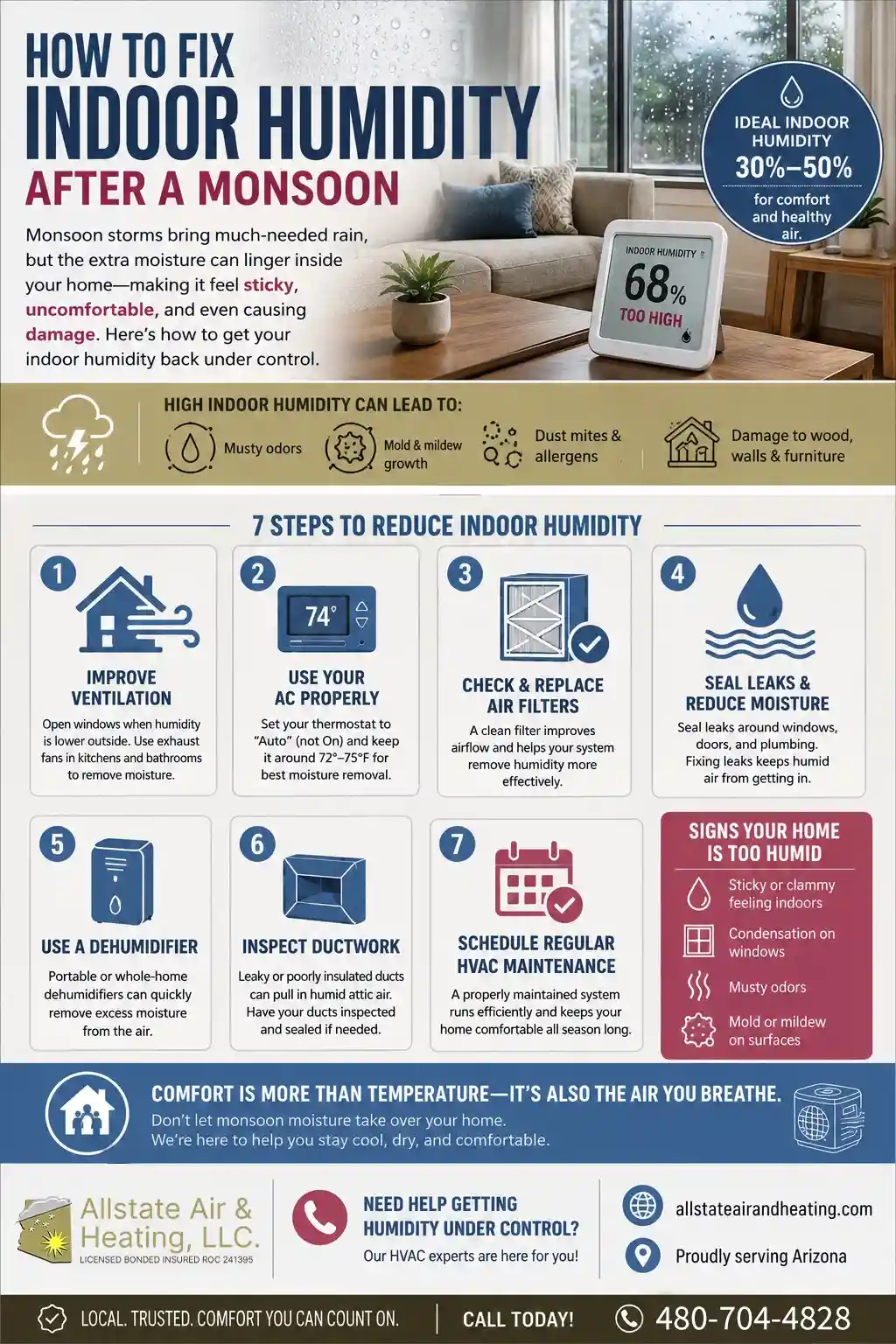
– Indoor relative humidity above 60% is linked to respiratory issues, mold growth, and allergy symptoms; maintaining 30-50% humidity is recommended for health and comfort.
– Strategies to manage indoor humidity after monsoons: Use inexpensive hygrometers to monitor humidity, keeping it between 30-50%, with occasional allowance up to 60% during severe monsoons.
Looking for a local, reliable and trustworthy HVAC Company? Allstate Air & Heating, LLC. is licensed for AC Installation, AC Repair, Smart Thermostat Installation, Air Duct Cleaning, Air Duct Repair and Dryer Vent Cleaning. For a free estimate call: 480-704-4828 or schedule an appointment online.
The Science Behind Arizona’s Monsoon Humidity Spike
How the North American Monsoon Impacts Your Home
The North American Monsoon is a powerful climatic shift that forces sudden, massive increases in atmospheric moisture across the Desert Southwest. During Arizona’s dry season (October through May), relative humidity levels average between 10-15%, contributing to the arid, desert environment. However, monsoon storms trigger a dramatic reversal, rapidly elevating humidity to above 50-70% in mere minutes.
Scientific studies show that monsoon moisture originates primarily from the Gulf of California and the Gulf of Mexico, moved north by a low-pressure trough forming over the Four Corners region. July and August alone bring nearly half of Arizona’s annual rainfall through intense thunderstorms accompanied by sustained humidity, lasting hours or days. Homes built for dry conditions suddenly must contend with tropical-like moisture loads they weren’t designed to handle.
The Clausius-Clapeyron Principle: Why Moisture Loads Are Increasing
Rising temperatures due to monsoon systems increase atmospheric water capacity, explained by the Clausius-Clapeyron relationship, which states that air holds approximately 7% more moisture for every degree Celsius increase in temperature. This thermodynamic principle is supported by extensive climate research and helps explain why monsoon humidity spikes have intensified in recent years.
As warm, moisture-rich air encounters cooler indoor surfaces, this excess humidity seeks to equalize indoors, driving up indoor moisture levels significantly after storms. This environmental reality places extra demands on your home’s HVAC system to control indoor humidity.
Why Your Air Conditioner Struggles to Remove Monsoon Moisture
Sensible vs. Latent Cooling: The Core HVAC Challenge
Most residential HVAC systems in Phoenix and Florence prioritize sensible cooling—lowering air temperature—but are ill-equipped to handle latent cooling, which is the removal of moisture from indoor air. These distinct processes operate differently: sensible cooling cools the air, while latent cooling physically extracts humidity.
Your AC achieves dehumidification by passing warm, humid air over cold evaporator coils, causing moisture to condense and drain away as liquid water. However, efficient dehumidification requires the system to run continuously for extended periods. Once the thermostat’s temperature setpoint (usually 74-78°F) is reached, typical AC systems cycle off prematurely, cutting short moisture removal.
During monsoon season, when outdoor humidity hovers between 50-70%, your AC might cool your home in 20 minutes then shut off, while effective dehumidification can demand 45 minutes or more of constant operation. This mismatch leaves your home cool but uncomfortably humid and damp.
The Problem of Short-Cycling
Short-cycling occurs when an oversized AC system runs for brief intervals before hitting the thermostat setpoint and turning off. Research underscores that this pattern prevents the evaporator coils from removing sufficient moisture, allowing humidity to build indoors.
An oversized unit cools rapidly but cuts off too soon to complete a proper dehumidification cycle, exacerbating the problem. Therefore, correctly sizing your AC system to your actual cooling load is critical for combating post-monsoon indoor humidity.
Common HVAC Issues That Amplify Post-Monsoon Humidity
| HVAC Problem | Impact on Indoor Humidity | Why It Fails During Monsoons |
|---|---|---|
| Oversized AC Unit | Cools quickly but cycles off before moisture removal completes | System shuts down on temperature, leaving relative humidity high |
| Inadequate Latent Load Capacity | Designed for dry conditions, struggles with sustained humidity spikes | Can’t remove moisture fast enough when outdoor humidity exceeds 50% |
| Dirty or Clogged Air Filters | Restricts airflow, causing uneven cooling and reduced coil efficiency | Impairs moisture condensation and drainage in ducts |
| Leaky or Poorly Insulated Ductwork | Allows humid outdoor air to infiltrate indoor spaces | Moist air bypasses evaporator coils, raising indoor humidity |
| Clogged Condensate Drain Line | Leads to water backup, overflow, and mold growth in HVAC system | High condensation exceeds drainage capacity during monsoons |
| Incorrect Refrigerant Charge | Reduces cooling and moisture removal efficiency | Refrigerant imbalance prevents proper coil temperature and condensation |
Air Duct Contamination: A Hidden Source of Moisture Retention
How Dirty Ducts Trap Moisture and Reduce HVAC Efficiency
Haboobs—massive dust storms that often precede monsoon rains—introduce fine particulate matter into your home’s duct system through unsealed gaps around HVAC returns, windows, and doors. When monsoon rains follow, this dust transforms into a hygroscopic mud film inside the ducts, trapping moisture longer than clean surfaces.
This contaminated environment fosters mold and mildew growth, bacterial amplification, and moisture pooling, particularly in horizontal duct runs, significantly reducing airflow and system efficiency. These conditions cause your AC to work harder and shorten its lifespan.
Professional air duct cleaning removes these moisture-retaining contaminants, improving airflow by up to 40%, which enhances your HVAC system’s ability to fully dehumidify indoor air.
Looking for a local, reliable and trustworthy HVAC Company? Allstate Air & Heating, LLC. is licensed for AC Installation, AC Repair, Smart Thermostat Installation, Air Duct Cleaning, Air Duct Repair and Dryer Vent Cleaning. For a free estimate call: 480-704-4828 or schedule an appointment online.
Indoor Humidity and Health: Why It Matters
Maintaining Safe Relative Humidity Levels to Prevent Mold
The EPA and ASHRAE recommend keeping indoor relative humidity between 30% and 50% to inhibit mold growth and protect occupant health. Scientific models show that mold requires sustained surface relative humidity above roughly 85% for visible growth, but microbial colonies can begin developing within 24-48 hours on moist surfaces under warm conditions.
Condensation on surfaces—not just elevated airborne humidity—is the main trigger for mold, dust mites, and bacterial proliferation, all of which negatively impact indoor air quality and health.
Respiratory and Comfort Implications of High Indoor Humidity
Peer-reviewed research published in Indoor Air links indoor humidity above 60% to increased respiratory symptoms including coughing, wheezing, sore throat, and asthma exacerbations, especially in children. Elevated humidity also triggers allergic reactions to dust mites and mold spores, impairs immune function, and can disrupt sleep quality.
Conversely, maintaining humidity in the 30-50% range correlates with fewer respiratory issues and improved comfort and air quality perception among occupants.
Effective Strategies for Controlling Indoor Humidity After Monsoons
1. Right-Size Your AC System and Optimize Operation
Accurate load calculation, following ACCA Manual J standards, ensures your AC system matches your home’s specific cooling and moisture removal needs. Oversized units cause short-cycling, reducing humidity control, whereas appropriately sized equipment runs longer, more consistent cycles for thorough dehumidification.
Advanced AC systems with two-stage or variable-speed compressors run at lower capacity for extended periods, improving latent cooling and energy efficiency. Setting thermostats to prioritize humidity removal and using the fan in “Auto” mode (not “On”) prevents re-circulation of humid air after the compressor cycles off.
2. Install Whole-Home Dehumidifiers for Supplemental Moisture Control
When monsoon humidity overwhelms your AC’s latent capacity, whole-home dehumidifiers, integrated into ductwork, provide effective, energy-efficient supplemental moisture removal across all rooms. Modern desiccant-based systems use 10 to 30 times less energy than traditional refrigerant dehumidifiers, reducing HVAC loads and maintaining stable indoor humidity.
Costs typically range from $1,500 to $3,500 installed, with monthly operating expenses of $20 to $50 during monsoon months, often offset within 3-4 years through reduced AC runtime and extended equipment longevity.
3. Maintain Condensate Drain Lines Regularly
Clogged drain lines are common culprits behind indoor humidity; water backup can cause mold growth and water damage within your HVAC system and home. Look for water pooling near the air handler, musty odors, unexplained dampness, or stains on ceilings and walls.
Professional maintenance includes flushing drain lines with compressed air, installing guards to prevent blockage, applying biocides to inhibit microbial growth, and inspecting for leaks or corrosion. Schedule drain line servicing at least every six months, with more frequent checks during monsoon season.
4. Upgrade to High-Efficiency Air Filters
Standard 1-inch filters (MERV 6-8) inadequately capture dust and moisture, leading to dirty ducts that trap humidity and reduce system efficiency. Using MERV 11-13 or higher filters enhances particle capture, keeping ductwork cleaner and improving airflow for better coil condensation and drainage.
Change filters monthly during monsoon months and consider pleated or electrostatic options for superior performance, scheduling duct inspections if filters clog prematurely.
5. Seal and Insulate Your Ductwork
Leaky ducts allow humid outdoor air to infiltrate your home, bypassing the AC system and raising indoor moisture levels. EPA studies indicate 20-30% conditioned air loss through duct leaks, significantly increasing humidity and energy costs.
Professional sealing involves locating leaks through pressure or smoke testing, applying mastic sealants or specialized duct tape, insulating ducts to prevent condensation, and verifying proper duct slopes for drainage. Costs range between $200-$600 and can reduce HVAC energy use by up to 20% while dramatically improving humidity control.
6. Schedule Comprehensive HVAC Maintenance Before Monsoon Season
| Maintenance Task | Frequency | Humidity Control Benefit |
|---|---|---|
| Evaporator Coil Cleaning | Annually before monsoon | Removes blockage, improves moisture extraction efficiency by up to 30% |
| Refrigerant Charge Inspection | Annually | Ensures proper coil temperature for efficient dehumidification |
| Condenser Unit Cleaning | Quarterly; monthly during monsoons | Removes debris for optimal heat rejection and system capacity |
| Drain Line Flushing | Every 6 months; monthly during monsoon | Prevents backups and water damage |
| Ductwork Inspection | Annually | Identifies leaks and contamination |
| Thermostat Calibration | Annually | Ensures accurate temperature and humidity sensing |
Advanced HVAC Technologies and Solutions
Two-Stage and Variable-Speed Compressors
Single-stage AC units operating at full capacity quickly cool your home but don’t effectively manage humidity in monsoon conditions. Upgrading to two-stage compressors, which run predominantly at lower speeds, extends run times enabling fuller moisture extraction.
For even more precise control, inverter-driven variable-speed compressors adjust output dynamically, achieve steady temperatures, optimize dehumidification, and maximize energy savings.
UV-C Germicidal Lights and Air Quality Enhancements
Monsoon season encourages biological contaminants such as mold, bacteria, and viruses to proliferate inside ductwork, especially when rodent intrusion has occurred. The EPA recommends duct cleaning where visible mold exists, as microbial particles can become airborne and affect respiratory health.
Installing UV-C germicidal lights inside duct systems damages the DNA and RNA of microorganisms, preventing their replication and reducing the risk of airborne infections. This technology is a scientifically validated approach to maintaining a healthier indoor environment during humid months.
Monitoring and Post-Monsoon Inspection
Using Hygrometers for Real-Time Humidity Tracking
A simple hygrometer, costing under $50, offers homeowners immediate insight into indoor relative humidity levels, serving as a crucial first step toward humidity management. Place devices in key areas such as living rooms, bedrooms, near air handlers, kitchens, bathrooms, and crawl spaces to track moisture hotspots.
Aim to maintain consistent indoor humidity between 30-50%, though temporary increases to 55-60% may occur during severe monsoons without supplemental equipment.
Post-Monsoon HVAC Inspection Checklist
- Check condensate drains: A steady drip signals proper drainage; dryness during humid days indicates blockages.
- Inspect ductwork: Look for dust accumulation, moisture stains, or leaks.
- Listen for unusual noises: Rattling or hissing may reveal mechanical issues or refrigerant leaks.
- Verify thermostat accuracy: Ensure temperature and humidity sensors are functioning correctly.
- Look for water damage: Ceilings and walls near the air handler can reveal hidden leaks.
- Clean outdoor condenser: Remove mud, dust, and debris following storms.
- Confirm system startup stability: Restart only when electrical power stabilizes after outages.
Professional post-monsoon maintenance services, costing $150-$300, include full system inspections, duct cleaning, and drain line flushing to catch damage early and extend system life.
Trusted HVAC Brands and Expert Service from Allstate Air and Heating, LLC
Allstate Air and Heating, LLC specializes in expert repair, maintenance, and installation services for all major HVAC brands tailored for Arizona’s unique monsoon climate.
- York HVAC Repair & Installation
- Trane HVAC Repair & Installation
- Bryant HVAC Repair & Installation
- RUUD HVAC Repair & Installation
- Amana HVAC Repair & Installation
- Arcoaire HVAC Repair & Installation
- Goodman HVAC Repair & Installation
- American Standard HVAC Repair & Installation
- Carrier HVAC Repair & Installation
- Lennox HVAC Repair & Installation
Our certified technicians evaluate and optimize existing systems, install supplemental dehumidifiers, upgrade components, and ensure peak performance to keep your home comfortable and healthy during monsoon season.
Take Control of Your Indoor Environment Post-Monsoon
Arizona’s monsoon season poses significant humidity challenges that standard HVAC systems alone often cannot resolve. Understanding the scientific causes of these spikes, recognizing system limitations, and adopting targeted strategies empower homeowners to maintain healthy, comfortable indoor air quality.
From proper AC sizing, advanced compressor technology, whole-home dehumidifiers, to diligent maintenance and duct cleaning, each action plays a critical role in combating moisture intrusion and preventing mold and health risks. Utilizing hygrometers for monitoring and engaging professional HVAC services ensures your system is ready to meet the demanding monsoon months.
At Allstate Air and Heating, LLC, we are dedicated to helping Arizona homeowners protect their comfort and health with science-backed, evidence-based HVAC solutions. Contact us today at 480-704-4828 for a consultation, duct inspection, or service in Florence, Queen Creek, San Tan Valley, and surrounding communities.
Looking for a local, reliable and trustworthy HVAC Company? Allstate Air & Heating, LLC. is licensed for AC Installation, AC Repair, Smart Thermostat Installation, Air Duct Cleaning, Air Duct Repair and Dryer Vent Cleaning. For a free estimate call: 480-704-4828 or schedule an appointment online.